The Pharaoh's Gold: The Legend of the Urn at Petra's Treasury
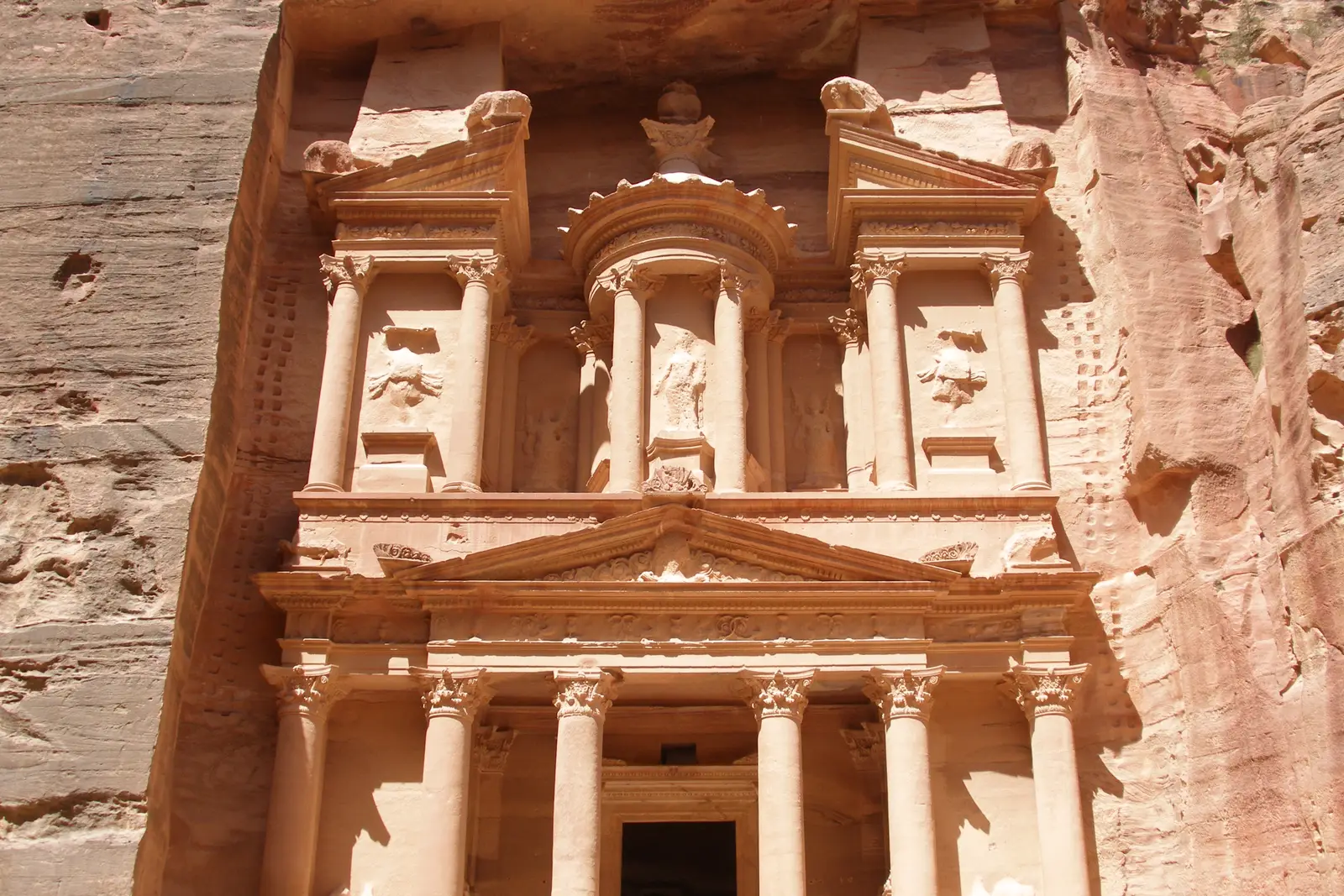
High on the facade of Petra's most famous monument sits a carved stone urn, and if you look closely you will see that it is scarred with small round holes. For generations, people believed this urn was full of gold hidden by an ancient pharaoh. The holes are the marks left by those who tried to bring the treasure down.
A treasure hidden in the rock
The local name of the monument tells the story. The Bedouin of the Petra mountains called it Khaznat al-Firaun, the Treasury of the Pharaoh. According to local legend, a pharaoh of Egypt once passed through these mountains carrying great riches. Travelling through the narrow gorges was slow and dangerous, so he used his magic to raise this magnificent building out of the cliff and placed his gold inside the urn at the very top, where no human hand could reach it.
Other versions of the tale change the owner of the treasure. Some say the gold belonged to a band of robbers who hid their loot high in the rock, and others speak of a forgotten king. But in every version the treasure is the same: sealed inside the stone urn, waiting above the heads of every traveller who walks out of the Siq.
The bullet marks on the urn
If the treasure was inside the urn, then breaking the urn should release it. That simple idea led local men, over many years, to fire their rifles at the top of the facade, hoping that a lucky shot would crack the stone and send a shower of gold coins into the sand below. Nothing ever fell, because the urn is carved from solid rock and was never hollow.
The shots did leave a mark, however. Through binoculars, or even with good eyes on a bright morning, you can still see the pitted surface of the urn. These small scars have become part of the monument's story, a reminder of how a legend once shaped the way people looked at Petra. Local guides are often happy to point the marks out and to retell the old story in their own words.
What historians and archaeologists know
The Treasury was carved by the Nabataeans, the Arab people who built Petra, most likely around the first century BC or the first century AD. No pharaoh had anything to do with it, and no treasure has ever been found in it. Most scholars believe it was built as a royal tomb or memorial, and many link it to King Aretas IV, one of the most powerful Nabataean rulers. Its facade, around 40 metres high, mixes Nabataean taste with styles borrowed from the Greek and Roman world.
In 2003, archaeologists digging in front of the facade found tombs below the present ground level. This showed that the original floor of the plaza was lower than it is today, and that the Treasury was part of a larger funerary complex. The real treasure of the building, scholars like to say, is the knowledge it holds about the Nabataeans.
Seeing the urn today
The best way to meet the Treasury is still the oldest one: walking through the Siq until the gorge opens and the facade appears in a slice of light. Arrive early in the morning, when the plaza is quiet and the sun begins to touch the rock. Visitors cannot enter the inner chamber, but you can stand close to the facade and study its carved figures. For a view of the urn at eye level, follow one of the trails that climb to viewpoints above the Treasury, ideally with a local guide. From there the bullet marks are easier to see, and the whole legend suddenly feels very close.
Frequently asked questions
Is there really treasure inside the urn of Petra's Treasury?
No. The urn at the top of the Treasury is carved from solid sandstone and has never been hollow. The story of hidden gold is a local legend, which is why the monument came to be called the Treasury. The small holes on the urn were made by people who fired at it in the hope of breaking it open, but no treasure was ever found.
Why is it called the Treasury if it was a tomb?
The name comes from the Bedouin legend that a pharaoh hid his gold in the urn on the facade. The Arabic name, Al-Khazneh, simply means the Treasury. Archaeologists believe the building was actually a royal tomb or memorial carved by the Nabataeans around 2,000 years ago, possibly for King Aretas IV.
Can you go inside Petra's Treasury?
Visitors are not allowed to enter the inner chamber of the Treasury, which helps protect the monument. You can stand in the plaza in front of the facade, look into the entrance from a distance and view the building from trails above it. The interior is a plain, square room, very different from the richly decorated exterior.
More stories
Ain Musa: The Spring of Moses at the Gates of Petra
Sheikh Ibrahim and the Rose-Red City: How Burckhardt Reached Petra in 1812
Lot's Wife, the Pillar of Salt and the Cave Above the Dead Sea
The Madaba Mosaic Map: The Oldest Map of the Holy Land Found Under a Church Floor
The Silent Faces of 'Ain Ghazal: Among the Oldest Statues of the Human Form
Jerash: The Roman City That Slept Under the Earth
Masters of Water: How the Nabataeans Made the Desert Bloom